The '''directional scanner''' ("d-scan") is a built-in device that comes with all ships and can detect most objects in space at long range. The directional-scanner is an extremely powerful searching tool, especially for PvP, in all sectors of space. A d-scan can cover an area with a range of up to about 14.3 AU (appx. 2 x10<sup>9</sup> km), and at an angle from 5° to 360°. When used the directional scanner lists all valid objects it can find within the scan area.
The '''directional scanner''' ("d-scan") is a built-in device that comes with all ships and can detect most objects in space at long range. The directional-scanner is an extremely powerful searching tool, especially for PvP, in all sectors of space. A d-scan can cover an area with a range of up to about 14.3 AU (appx. 2 x10<sup>9</sup> km), and at an angle from 5° to 360°. When used the directional scanner lists all valid objects it can find within the scan area.
The directional scanner can be used either defensively with full range and angle. This allows the user to see all new ships of probes that may pose threat. It can be also used offensively to gather intl on things that are off grid. This includes getting enemy fleet composition or approximate location of objects.
The directional scanner can be used either defensively with full range and angle (allowing the user to see all ships or probes that may pose threat), or offensively to gather intel on things that are off grid. This includes getting enemy fleet composition or approximate location of objects.
The directional scanner is especially important in [[wormholes]]. Since the local chat in them does not automatically show other players the directional scan is the first tool to show activity in system.
The directional scanner is especially important in [[wormholes]]. Since the local chat in them does not automatically show other players the directional scan is the first tool to show activity in system.
Line 10:
Line 10:
[[image:Qs_openDscan.jpg|200px|thumb|Directional scanner window with labels.]]
[[image:Qs_openDscan.jpg|200px|thumb|Directional scanner window with labels.]]
[[image:Qs Dscan14-360.jpg|440px|thumb|Directional scanner window with labels.]]
[[image:Qs Dscan14-360.jpg|440px|thumb|Directional scanner window with labels.]]
The directional scanner does not scan the space automatically, instead it must be operated manually. Every time the scan button or hotkey is pressed the list in directional scanner window updates to show all visible objects within the scan cone. The scan wil also refresh after changing range, angle or filter in directional scanner. It also refreshes after jumping into another system. After a scan, it takes two seconds for the scanner to reset, after which you can initiate another scan.
The directional scanner does not scan the space automatically, instead it must be operated manually. Every time the scan button or hotkey is pressed the list in the directional scanner window updates to show all visible objects within the scan cone. The scan will also refresh after changing range, angle or filter in directional scanner. It also refreshes after jumping into another system. After a scan it takes two seconds for the scanner to reset, after which you can initiate another scan.
The directional scanner can see the following objects in space:
The directional scanner can see the following objects in space:
* All ships and their names.This excludes [[Recon Ships|combat recon]] and cloaked ships.
* All ships and their names. This excludes [[Recon Ships|combat recon]] and cloaked ships.
* Celestial objects such as moons, asteroid belts and planets.
* Celestial objects such as moons, asteroid belts and planets.
* Structures such as [[POS|player starbases]], citadels, customs offices, mobile depots and stargates. The name of the structure is also visible.
* Structures such as [[POS|player starbases]], citadels, customs offices, mobile depots and stargates. The name of the structure is also visible.
Line 21:
Line 21:
* NPCs with "♦" in their name. This includes mining operations and Blood Raider Shipyard fleets.
* NPCs with "♦" in their name. This includes mining operations and Blood Raider Shipyard fleets.
The directional scanner is limited by not being able to see the state of the object (empty, damaged, reinforced, pilot info). The directional scanner is also unable to see cosmic signatures, cosmic anomalies, all normal NPCs, beacons and bookmarks. The directional scanner is also unable to see [[Recon Ships|combat recon]] ships and cloaked ships.
The directional scanner is limited by not being able to see the state of the object (empty, damaged, reinforced, pilot info). The directional scanner is also unable to see cosmic signatures, cosmic anomalies, all normal NPCs, beacons and bookmarks.
The directional scanner is opened by pressing Alt+D. Or, you can open it by clicking the "radar" button, above the autopilot button but below the cargohold button on the left-hand side of your HUD, and when the window with the three scanners opens, choose the directional scanner.
The directional scanner is opened by pressing Alt+D. Or, you can open it by clicking the "radar" button, above the autopilot button but below the cargohold button on the left-hand side of your HUD, and when the window with the three scanners opens, choose the directional scanner.
Line 31:
Line 31:
The directional scanner lists visible objects that are within its scan cone. This scan cone is defined by the scan range, scan angle and scan direction.
The directional scanner lists visible objects that are within its scan cone. This scan cone is defined by the scan range, scan angle and scan direction.
The maximum range at which directional scan can scan is approximately 14.355 [https://en.wikipedia.org/wiki/Astronomical_unit AU] (appx. 2 x10<sup>9</sup> km) but the range can be adjusted either by using the steps in slider (1, 5, 10, 14.3 AU). These settings are often sufficient; but if you wish, you can type a specific scan range into the box for any distance up to the maxium. If you click on the AU label button, it will change to KM and adjust the value of the range accordingly.
The maximum range at which directional scan can scan is approximately 14.355 [https://en.wikipedia.org/wiki/Astronomical_unit AU] (appx. 2 x10<sup>9</sup> km) but the range can be adjusted either by using the steps in slider (1, 5, 10, 14.3 AU). These settings are often sufficient; but if you wish, you can type a specific scan range into the box for any distance up to the maximum. If you click on the AU label button, it will change to KM and adjust the value of the range accordingly.
The other parameter controlling the shape of the scan cone is scan angle. The angle can't be selected arbitarily so you are limited to the slider steps (5°, 15°, 30°, 60°, 90° 180° and 360°). The scan is always directed to what '''your camera points''' at and does not care about ship orientation.
The other parameter controlling the shape of the scan cone is scan angle. The angle can't be selected arbitrarily so you are limited to the slider steps (5°, 15°, 30°, 60°, 90° 180° and 360°). The scan is always directed to what '''your camera points''' at and does not care about ship orientation.
Because camera manipulation is involved, you may find it helpful to enable Overview brackets to help you see things in space. With brackets enabled, you can align the camera by moving the target celestial's icon toward your ship's indicator. This was a useful technique prior to the introduction of the map, and some pilots may prefer it.
Because camera manipulation is involved, you may find it helpful to enable Overview brackets to help you see things in space. With brackets enabled, you can align the camera by moving the target celestial's icon toward your ship's indicator. This was a useful technique prior to the introduction of the map, and some pilots may prefer it.
Check the [[Overview Guide#Setting Up Bracket Presets|Overview Guide]] to see how to change what bracets are visible. You can press Alt+Z to turn all brackets on and off.
Check the [[Overview Guide#Setting Up Bracket Presets|Overview Guide]] to see how to change what brackets are visible. You can press Alt+Z to turn all brackets on and off.
===Filter===
===Filter===
Line 49:
Line 49:
Some common filters and their uses. These are often mixed to create filter for specific situations:
Some common filters and their uses. These are often mixed to create filter for specific situations:
* Ships. Visible ship, especially moving ones, are indicators that someone is active in the system.
* Ships. Visible ship, especially moving ones, are indicators that someone is active in the system.
* Drones. Drones appearin in space with a ship indicate active combat.
* Drones. Drones appearing in space with a ship indicate active combat.
* Wrecks. Wrecks stay in space for two hours so if any are visible there has been someone fighting recently.
* Wrecks. Wrecks stay in space for two hours so if any are visible there has been someone fighting recently.
* Core scanner probes. With this you can see if someone is scanning sites. Especially useful when running sites yourself as the hostile must scan your site before warping in.
* Core scanner probes. With this you can see if someone is scanning sites. Especially useful when running sites yourself as the hostile must scan your site before warping in.
* Combat scanner probes. Seeing these in space is clear indicator of hostile intent.
* Combat scanner probes. Seeing these in space is clear indicator of hostile intent.
* Control towes and force fields. The force field of an active control tower is separate object in directional scan. Tells if anyone is living in the system.
* Control towers and force fields. The force field of an active control tower is separate object in directional scan. Tells if anyone is living in the system.
** Precision scans can be used to see if a ship is near forcefield indicating unpiloted ship parked inside force field.
** Precision scans can be used to see if a ship is near forcefield, indicating unpiloted ship parked inside force field.
** When gathering intel on hostile towers you can take short range scan of the tower with all structures enabled and copy theresults.
** When gathering intel on hostile towers you can take short range scan of the tower with all structures enabled and copy the results.
* Upwell structures. While undockable structures aren't visible in overview they are visible in directional scan.
* Upwell structures. While undockable structures aren't visible in overview they are visible in directional scan.
Line 69:
Line 69:
The directional scanner has many useful features integrated to the system map.
The directional scanner has many useful features integrated to the system map.
"Dock in solar system map" ties the directional scanner to solar system map. With this enabled opening and closing system map/directional scanner will also open or close the other. You should disable this so you can have directional scanner open without opening the map.
"Dock in solar system map" ties the directional scanner to solar system map. With this enabled opening and closing system map/directional scanner will also open or close the other. You should undock the directional scanner from the solar system map so you can have directional scanner all the time.
"Align with camera" ties map camera and space camera together allowing you to aim the directional scanner in the map window.
"Align with camera" ties map camera and space camera together allowing you to aim the directional scanner in the map window.
Line 79:
Line 79:
==Practical applications==
==Practical applications==
In solo PVP the d-scanner can be used to locate opponents. In fleets it is common for intel reports to be made by pasting the scanner results into an [[#Scouting|online parser]]. These can give a Fleet Commander intelligence on enemy fleet compositions to help decide whether an engagement is worth pursuing. Directional scanning is also widely used in mining and exploring to give early warning of hostile ships and/or combat probes. Good scanning can provide the vital seconds needed to escape an incoming attack.
In solo PVP the d-scanner can be used to locate opponents at celestials (any stationary object in space) or cosmic signatures or cosmic anomalies.
In fleets it is common for intel reports to be made by pasting the scanner results into an [[#Scouting|online parser]]. These can give a Fleet Commander intelligence on enemy fleet compositions to help decide whether an engagement is worth pursuing. Directional scanning is also widely used in mining and exploring to give early warning of hostile ships and/or combat probes. Good scanning can provide the vital seconds needed to escape an incoming attack.
The d-scan is a tool whose fundamental function is to detect hostile targets before a PvP engagement happens - whether they are trying to find you, or you are looking for them. Because it is standard equipment in every ship, and because it requires no specialized training, the d-scan is most pilots' first call for intelligence.
The d-scan is a tool whose fundamental function is to detect hostile targets before a PvP engagement happens - whether they are trying to find you, or you are looking for them. Because it is standard equipment in every ship, and because it requires no specialized training, the d-scan is most pilots' first call for intelligence.
Line 115:
Line 117:
{{clear}}
{{clear}}
The first time you do this, it seems clunky. Setting and scanning takes awhile. But after a few tries, it becomes second nature. You set up the d-scan filter before you even enter the system, and you know from experience what ranges and angles you need to use. In cases where you are looking for ships that can be found in fixed locations ... in asteroid belts, for example, or undocking from a particular station ... this method will find more targets faster than probe scanning will. (You still need probes, though, in, for example, situations where your target might be off the grid, or where the target is not located near an object that you can warp to. Remember that the d-scanner never gives you coordinates.)
The first time you do this, it seems clunky. Setting and scanning takes awhile. But after a few tries, it becomes second nature. You set up the d-scan filter before you even enter the system, and you know from experience what ranges and angles you need to use. In cases where you are looking for ships that can be found in fixed locations ... in asteroid belts, for example, or undocking from a particular station ... this method will find more targets faster than probe scanning will. (You still need probes in situations where your target might be off the grid, or where the target is not located near an object that you can warp to. Remember that the d-scanner never gives you coordinates.)
===Defensive Scanning===
===Defensive Scanning===
Line 130:
Line 132:
Your goal is to spot ships as soon as they come into range, decide whether they are potentially hostile, and then decide how to respond. There are no specific rules for doing this; you will need to develop a plan that is comfortable for you, but here are a few basic techniques.
Your goal is to spot ships as soon as they come into range, decide whether they are potentially hostile, and then decide how to respond. There are no specific rules for doing this; you will need to develop a plan that is comfortable for you, but here are a few basic techniques.
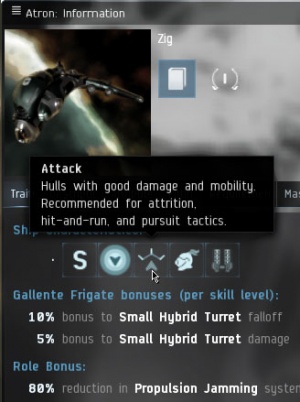
* '''Know your ships'''. Industrials, and even combat ships that are significantly less powerful than yours, can be ignored. [[File:Qs 11dscanprac.jpg|right|thumb|Show Info window for a potential hostile ship.]]You might want to set your Info Window to "Traits". That way if a ship you've never seen before shows up in the scanner, you can do a quick Show Info and immediately see its size and combat characteristics.
* '''Know your ships'''. Industrials, and even combat ships that are significantly less powerful than yours, can be ignored. [[File:Qs 11dscanprac.jpg|right|thumb|Show Info window for a potential hostile ship.]]You might want to set your Info Window to "Traits". That way if a ship you've never seen before shows up in the scanner, you can do a quick Show Info and immediately see its size and combat characteristics.
* '''Spam to danger level'''. If you are in a wormhole, you probably want to be spamming the scan every few seconds or so ... every 8-10 seconds is often recommended. You do this because ANY ship that shows up is likely to be dangerous, and many will have expert pilots who can locate you very quickly. In a wormhole you may only have seconds to respond to an intrusion, so spam the scan and get every advantage that you can. In a level 0.9 system you may only want to scan every minute or so. Some people don't scan at all in high sec ... but the danger is still there ... high sec gankers are often slow and inexperienced, so you can get away with LESS scanning, but it is tempting fate to do NONE.
* '''Spam to danger level'''. If you are in a wormhole, you probably want to be spamming the scan every few seconds or so ... every 8-10 seconds is often recommended. You do this because ANY ship that shows up is likely to be dangerous, even industrials and exploration frigates, and many will have expert pilots who can locate you very quickly. In a wormhole you may only have seconds to respond to an intrusion, so spam the scan and get every advantage that you can. In a level 0.9 system you may only want to scan every minute or so. Some people don't scan at all in high sec ... but the danger is still there ... high sec gankers are often slow and inexperienced, so you can get away with LESS scanning, but it is tempting fate to do NONE.
* '''Align to exit'''. When you set up your operation, take the time to point your ship in the direction you want to warp should you need to run. This may not turn out to be helpful in terms of speed, but it gives you one less thing to think about if a hostile suddenly appears.
* '''Align to exit'''. When you set up your operation, take the time to point your ship in the direction you want to warp should you need to run. This may not turn out to be helpful in terms of speed, but it gives you one less thing to think about if a hostile suddenly appears.
*'''Move around'''. Particularly if you are mining, when you finish an asteroid, move to another belt and repeat. There are a variety of combat ships that your scanner simply cannot see, and there is no worse feeling that the sudden panic that you feel when a ship decloaks and tackles you. The longer you sit in one place, the more vulnerable you become.
*'''Move around'''. Particularly if you are mining, when you finish an asteroid, move to another belt and repeat. There are a variety of combat ships that your scanner simply cannot see, and there is no worse feeling that the sudden panic that you feel when a ship decloaks and tackles you. The longer you sit in one place, the more vulnerable you become.
Line 138:
Line 140:
==== Probes ====
==== Probes ====
While a good pilot can find you quickly using the d-scan, some hostiles rely primarily on combat probes. In any case, you should always use a d-scan filter that include probes.
While a good pilot can find you quickly using the d-scan, some hostiles rely primarily on combat probes. In any case, you should always use a d-scan filter that include probes.
* While "core" scanner probes cannot locate ships, their presence may indicate an invisible ship. So you should include them in your filter.
* While "core" scanner probes cannot locate ships, their presence may indicate a cloaked ship. So you should include them in your filter.
* It will generally take at least 4 "combat" probes at a distance of 2 AU or less to pinpoint your position. A good rule of thumb is to run the scan at 360° at a range of 5-10 AU. Probes outside that range are not close to finding you, and ships outside that range will probably take some time to get a fix on your position.
* It will generally take at least 4 "combat" probes at a distance of 2 AU or less to pinpoint your position. A good rule of thumb is to run the scan at 360° at a range of 5-10 AU. Probes outside that range are not close to finding you, and ships outside that range will probably take some time to get a fix on your position.
Probes themselves cannot hurt you; it is the ships that are controlling them that you have to worry about. Core scanner probes at a long distance may just be someone scanning for resources and probably should just be watched. Combat probes close to you should suggest a very high level of danger.
Probes themselves cannot hurt you; it is the ships that are controlling them that you have to worry about. Core scanner probes at a long distance may just be someone scanning for resources and probably should just be watched. Combat probes close to you should suggest a very high level of danger.
==== Invisibles ====
==== Cloaky Ships ====
Remember that cloaked ships and certain "scan immune" ships will not appear on the directional scanner, so covert ops frigates, stealth bombers, recons and Tech 3 strategic cruisers (in some configurations) will be able to warp to you without being detected.
Remember that cloaked ships and certain "scan immune" ships will not appear on the directional scanner, so covert ops frigates, stealth bombers, recons, and Tech 3 strategic cruisers (in some configurations) will be able to warp to you without being detected.
* If an invisible ship is using probes, the probes will show up on your scan even though the ship will not. So if you see probes, but no ship, assume that an invisible ship is out there somewhere.
* If a cloaked ship is using probes, the probes will show up on your scan even though the ship will not. So if you see probes, but no ship, assume that a cloaked ship is out there somewhere.
* Depending on a pilot's skill, cloaked ships may become visible for a few seconds as they move away just after coming through a gate. If you see a brief contact that isn't there when you rescan, treat it seriously. (This is also a good argument for frequent rescanning, even in higher sec systems.)
* Depending on a pilot's skill, cloaked ships may become visible for a few seconds as they move away just after coming through a gate. If you see a brief contact that isn't there when you rescan, treat it seriously. (This is also a good argument for frequent rescanning, even in higher sec systems.)
* Buying and equipping an invisible ship is usually an expensive proposition, and making piracy pay depends not on the ships killed, but the cargos. Many pilots will wait patiently for you to fill your cargo hold before they attack. On your part, you need to know the risk/reward situation. Maybe your ore hold is only half full, but if this is a dangerous system, it still may be time to warp to a base and empty it out. Maybe you haven't checked every artifact that you can see ... but what is the value of the stuff in your cargo hold? Know the risk; and head out when you have enough.
* Buying and equipping a cloak ship is usually an expensive proposition, and making piracy pay depends not on the ships killed, but the cargo. Many pilots will wait patiently for you to fill your cargo hold before they attack. On your part, you need to know the risk/reward situation. Maybe your ore hold is only half full, but if this is a dangerous system, it still may be time to warp to a base and empty it out. Maybe you haven't checked every artifact that you can see ... but what is the value of the stuff in your cargo hold? Know the risk; and head out when you have enough.
* Pilots of invisibles tend to be careful and methodical. So, especially when mining, if you move frequently, causing them to need to restart their search, they may either decide that it's too much work, or they may move too fast and make a mistake. Try not to stay in the same place for very long.
* Pilots of cloaky ships tend to be careful and methodical. So, especially when mining, if you move frequently, causing them to need to restart their search, they may either decide that it's too much work, or they may move too fast and make a mistake. Try not to stay in the same place for very long.
===Scouting===
===Scouting===
Line 155:
Line 157:
:Note: ''To move the entire results of a scan. Click one of the result items. Press Ctrl+A to select all items. Press Ctrl+C to copy all the results. Go to where you want to put the results and press Ctrl+V to paste them.''
:Note: ''To move the entire results of a scan. Click one of the result items. Press Ctrl+A to select all items. Press Ctrl+C to copy all the results. Go to where you want to put the results and press Ctrl+V to paste them.''
The d-scanner can also be used to check gates for [[gatecamps|gate camps]] without warping to the gate's grid. You will need to have an off-grid bookmark near the gate from which you can scan it.
The d-scanner can also be used to check gates for [[gatecamps|gate camps]] or warp disruption bubbles (in null-sec) without warping to the gate's grid. You will need to have an off-grid bookmark near the gate from which you can scan it.
In low or null-sec, directional scanning can be used to check for player owned starbases ([[POS_and_YOU|POS]]) and other interesting structures near moons, bases or belts.
In low or null-sec, directional scanning can be used to check for player owned starbases ([[POS_and_YOU|POS]]) and other interesting structures near moons, bases or belts.
Revision as of 18:16, 4 February 2018
This article should be cleaned up or improved. The reason is: unspecified
The directional scanner ("d-scan") is a built-in device that comes with all ships and can detect most objects in space at long range. The directional-scanner is an extremely powerful searching tool, especially for PvP, in all sectors of space. A d-scan can cover an area with a range of up to about 14.3 AU (appx. 2 x10⁹ km), and at an angle from 5° to 360°. When used the directional scanner lists all valid objects it can find within the scan area.
The directional scanner can be used either defensively with full range and angle (allowing the user to see all ships or probes that may pose threat), or offensively to gather intel on things that are off grid. This includes getting enemy fleet composition or approximate location of objects.
The directional scanner is especially important in wormholes. Since the local chat in them does not automatically show other players the directional scan is the first tool to show activity in system.
How it works
Directional scanner window with labels.Directional scanner window with labels.
The directional scanner does not scan the space automatically, instead it must be operated manually. Every time the scan button or hotkey is pressed the list in the directional scanner window updates to show all visible objects within the scan cone. The scan will also refresh after changing range, angle or filter in directional scanner. It also refreshes after jumping into another system. After a scan it takes two seconds for the scanner to reset, after which you can initiate another scan.
The directional scanner can see the following objects in space:
All ships and their names. This excludes combat recon and cloaked ships.
Celestial objects such as moons, asteroid belts and planets.
Structures such as player starbases, citadels, customs offices, mobile depots and stargates. The name of the structure is also visible.
Wrecks
Drones
Core and combat scanning probes
NPCs with "♦" in their name. This includes mining operations and Blood Raider Shipyard fleets.
The directional scanner is limited by not being able to see the state of the object (empty, damaged, reinforced, pilot info). The directional scanner is also unable to see cosmic signatures, cosmic anomalies, all normal NPCs, beacons and bookmarks.
The directional scanner is opened by pressing Alt+D. Or, you can open it by clicking the "radar" button, above the autopilot button but below the cargohold button on the left-hand side of your HUD, and when the window with the three scanners opens, choose the directional scanner.
To get more precise results the directional scanner allows controlling range, angles and filter.
Scan cone
The directional scanner lists visible objects that are within its scan cone. This scan cone is defined by the scan range, scan angle and scan direction.
The maximum range at which directional scan can scan is approximately 14.355 AU (appx. 2 x10⁹ km) but the range can be adjusted either by using the steps in slider (1, 5, 10, 14.3 AU). These settings are often sufficient; but if you wish, you can type a specific scan range into the box for any distance up to the maximum. If you click on the AU label button, it will change to KM and adjust the value of the range accordingly.
The other parameter controlling the shape of the scan cone is scan angle. The angle can't be selected arbitrarily so you are limited to the slider steps (5°, 15°, 30°, 60°, 90° 180° and 360°). The scan is always directed to what your camera points at and does not care about ship orientation.
Because camera manipulation is involved, you may find it helpful to enable Overview brackets to help you see things in space. With brackets enabled, you can align the camera by moving the target celestial's icon toward your ship's indicator. This was a useful technique prior to the introduction of the map, and some pilots may prefer it.
Check the Overview Guide to see how to change what brackets are visible. You can press Alt+Z to turn all brackets on and off.
Filter
With the filter set to "All", anything that can be picked up by the scanner will be displayed, potentially creating a lot of clutter and making it hard to find the desired objects. A variety of other settings can be used to focus attention on a smaller number or more specific category of objects.
The directional scanner can use any of your overview presets to filter the results. When you click the filter selector in top right corner of directional scan window you can select the overview to use as a filter. You can also choose to use active overview as the filter.
When a filter is active the directional scan will only show objects that would show on the used overview. The directional scanner hovewer does not see any other info on the objects than its type and name. This means that the filtering function will not take into account any of the state settings the overview may have. This means that you can not filter the directional scan by attributes like standing, corp or alliance.
Some common filters and their uses. These are often mixed to create filter for specific situations:
Ships. Visible ship, especially moving ones, are indicators that someone is active in the system.
Drones. Drones appearing in space with a ship indicate active combat.
Wrecks. Wrecks stay in space for two hours so if any are visible there has been someone fighting recently.
Core scanner probes. With this you can see if someone is scanning sites. Especially useful when running sites yourself as the hostile must scan your site before warping in.
Combat scanner probes. Seeing these in space is clear indicator of hostile intent.
Control towers and force fields. The force field of an active control tower is separate object in directional scan. Tells if anyone is living in the system.
Precision scans can be used to see if a ship is near forcefield, indicating unpiloted ship parked inside force field.
When gathering intel on hostile towers you can take short range scan of the tower with all structures enabled and copy the results.
Upwell structures. While undockable structures aren't visible in overview they are visible in directional scan.
It is strongly recommended that you create overviews specifically for being used as directional scan filters and use them.
Common filters include probes to give early warning if someone is attempting to locate you, ships for obvious reasons and structures to tell if someone is actively living in the system.
How to set up to the E-UNI standard is shown in the Overview Guide.
System map
The scan cone as seen in system map.The scan can be aimed at an object in map.
The directional scanner has many useful features integrated to the system map.
"Dock in solar system map" ties the directional scanner to solar system map. With this enabled opening and closing system map/directional scanner will also open or close the other. You should undock the directional scanner from the solar system map so you can have directional scanner all the time.
"Align with camera" ties map camera and space camera together allowing you to aim the directional scanner in the map window.
"Show scan cone" displays the scan cone in system map. In addition to showing the cone this will also highight all objects on the map that are inside the scan cone.
The map can be also used to quicly aim the directional scanner to any object visible in the map. To do this hold right click on an object and select "directional scan" in the radial menu that opens.
Practical applications
In solo PVP the d-scanner can be used to locate opponents at celestials (any stationary object in space) or cosmic signatures or cosmic anomalies.
In fleets it is common for intel reports to be made by pasting the scanner results into an online parser. These can give a Fleet Commander intelligence on enemy fleet compositions to help decide whether an engagement is worth pursuing. Directional scanning is also widely used in mining and exploring to give early warning of hostile ships and/or combat probes. Good scanning can provide the vital seconds needed to escape an incoming attack.
The d-scan is a tool whose fundamental function is to detect hostile targets before a PvP engagement happens - whether they are trying to find you, or you are looking for them. Because it is standard equipment in every ship, and because it requires no specialized training, the d-scan is most pilots' first call for intelligence.
Offensive Scanning
An important use of the directional scanner is to find potential PVP targets. Keep in mind that the scanner only returns ship names and types; never the pilot's name. (This is the reason why you should rename your ships as soon as you buy them. Your name also appears on the system chat list, and an enemy can match the name with the ship.) Nor will the d-scan provide you with the specific distance to a ship, or its coordinates.
The best way to show the use of the d-scan to locate ships is by example. Since every ship, even your capsule, has a d-scanner, you can do this exercise yourself ... and this is the best way to learn how it works. The next few images were created at High Sec Campus in Amygnon. This is a good place to practice scanning because there are almost always a bunch of ships in system.
Even if you mostly plan to mine or explore, it is worthwhile at least reading this section. Hostile ships WILL be looking for you, and this is how they do it. If you try it yourself, you will have a better feel for the process and more easily defeat it when it happens to you.
(This is but one example. There are a variety of offensive d-scan techniques, covering different tactical situations. D-Scan 102 provides an in-depth look at many of these.)
Celestials in directional scanner.
So ... imagine that a hunter is looking for mining targets. The first thing that he or she does is to enter a system and look at the Overview to find a moon or planet with a number of nearby asteroid belts. In this case Amygnon VIII has three belts within d-scan range. So the hunter warps to the moon. The plan is to scan each of the asteroid belts looking for mining ships. Although the scanner will not give the range to a ship, it will give the range to the asteroid belt, enabling the hunter to warp in farily close to the target.
View of the planet, its moons and asteroid belts on the map.
Notice that the icon for asteroid belt on the Overview is a pyramid of three dots. This same icon will be used in the d-scan map to show belts.
Next the hunter sets the scanner range to match that of the farthest asteroid belt (in this case 5 AU), and sets the angle to something that will blanket the belt (in this case 30°). Using the first menu at the top left of the Map, the hunter unchecks all the boxes except for Asteroid Belts. The next step is to zoom the Map in as close as possible.
Use the radial menu inside the Map to aim the scanner.
As you can see on the image to the right, only asteroid belts are now marked on the map (the icon for a belt is a cluster of 3 dots). The hunter selects one of these, and using the radial menu (left click on the belt icon and choose the scanner icon when it pops up) points the scanner; then the hunter initiates a scan.
That first scan is empty (and not shown here). So the hunter clicks on the next belt icon, aims the scanner and takes another snapshot. This second scan shows three ships: a Skiff, a Miasmos and a Moa. Keep in mind that the scanner is finding ALL visible ships in its range, and since there some stations nearby, ships docking and undocking will show up in the scan. On the other hand, the Skiff is a mining vessel, and likely to be in the asteroid belt.
So the hunter warps to that belt. At this point, the Skiff shows up in the Overview at a distance of 123K and can be targeted.
Let's assume that the Skiff pilot, a good Unista, has been keeping close watch and has noticed the hunter's ship as it was lurking by the moon making these scans. The Skiff would not know where the hunter was, but it would know what the hunter was. So even as the hunter is warping in, the Skiff has finished pulling in its drones and aligning for warp. And away it goes!
No problem. The hunter now goes back to the map, selects the third asteroid belt and repeats the scanning process. There it finds a Procurer, surrounded by cargo containers and dead belt pirates. This belt is only 0.3 AU away, and the hunter warps in a mere 21 K from the Procurer.
A short, one-sided fight occurs, and then the hunter grabs the loot and departs from the system.
The first time you do this, it seems clunky. Setting and scanning takes awhile. But after a few tries, it becomes second nature. You set up the d-scan filter before you even enter the system, and you know from experience what ranges and angles you need to use. In cases where you are looking for ships that can be found in fixed locations ... in asteroid belts, for example, or undocking from a particular station ... this method will find more targets faster than probe scanning will. (You still need probes in situations where your target might be off the grid, or where the target is not located near an object that you can warp to. Remember that the d-scanner never gives you coordinates.)
Defensive Scanning
"Defense" refers to the need to scan for possibly hostile ships while mining or exploring. A better term for this might be "situational awareness" - the need to keep an eye on your environment whenever you are in dangerous territory.
Various articles in the UNIWiki discuss the tactics of survival while exploring or mining. For example:
From Surviving While Exploring: "While running the site, and particularly while in the minigame, keep your overview and Local visible, and keep running D-Scan."
Guide to Ice Mining: "...set your D-scan so it's open and accessible. You'll need this for multiple purposes."
You will want to read about the specifics of your own profession, but here are a few general comments about using the d-scan for situational awareness.
Spam Scan
Naturally, you will scan the system before you set up your operation. Once you are started, however, you should refresh the scan periodically. You can rescan by clicking on the large SCAN buttion, or you can set up the "Refresh Directional Scan" hotkey.
This hotkey is off by default, so you will have to set it up manually. Open the Game Preferences window (ESC), go to the "Shortcuts" tab, and then go to the "Combat" tab inside of Shortcuts. Find the "Refresh Directional Scan" hotkey and set it to the key of your choice. If you plan to be mining or exploring a lot, you are going to use the key often, so choose a key that's very easy to strike.
Your goal is to spot ships as soon as they come into range, decide whether they are potentially hostile, and then decide how to respond. There are no specific rules for doing this; you will need to develop a plan that is comfortable for you, but here are a few basic techniques.
Know your ships. Industrials, and even combat ships that are significantly less powerful than yours, can be ignored. Show Info window for a potential hostile ship.You might want to set your Info Window to "Traits". That way if a ship you've never seen before shows up in the scanner, you can do a quick Show Info and immediately see its size and combat characteristics.
Spam to danger level. If you are in a wormhole, you probably want to be spamming the scan every few seconds or so ... every 8-10 seconds is often recommended. You do this because ANY ship that shows up is likely to be dangerous, even industrials and exploration frigates, and many will have expert pilots who can locate you very quickly. In a wormhole you may only have seconds to respond to an intrusion, so spam the scan and get every advantage that you can. In a level 0.9 system you may only want to scan every minute or so. Some people don't scan at all in high sec ... but the danger is still there ... high sec gankers are often slow and inexperienced, so you can get away with LESS scanning, but it is tempting fate to do NONE.
Align to exit. When you set up your operation, take the time to point your ship in the direction you want to warp should you need to run. This may not turn out to be helpful in terms of speed, but it gives you one less thing to think about if a hostile suddenly appears.
Move around. Particularly if you are mining, when you finish an asteroid, move to another belt and repeat. There are a variety of combat ships that your scanner simply cannot see, and there is no worse feeling that the sudden panic that you feel when a ship decloaks and tackles you. The longer you sit in one place, the more vulnerable you become.
How you respond to a potentially hostile contact depends on your ship's capabilities, your location, and your level of paranoia. If you are mining in an asteroid belt within a few AU of a station, for example, you may see a constant flow of combat ships passing through your scanner. It's the ship that persists on your scan for more than a few seconds that ought to concern you. A reasonable response might be to move to a more distant asteroid belt and watch to see if the same ship reappears. On the other hand, there are very few reasons to be passing through a wormhole, so any contact should be treated with deep suspicion.
Probes
While a good pilot can find you quickly using the d-scan, some hostiles rely primarily on combat probes. In any case, you should always use a d-scan filter that include probes.
While "core" scanner probes cannot locate ships, their presence may indicate a cloaked ship. So you should include them in your filter.
It will generally take at least 4 "combat" probes at a distance of 2 AU or less to pinpoint your position. A good rule of thumb is to run the scan at 360° at a range of 5-10 AU. Probes outside that range are not close to finding you, and ships outside that range will probably take some time to get a fix on your position.
Probes themselves cannot hurt you; it is the ships that are controlling them that you have to worry about. Core scanner probes at a long distance may just be someone scanning for resources and probably should just be watched. Combat probes close to you should suggest a very high level of danger.
Cloaky Ships
Remember that cloaked ships and certain "scan immune" ships will not appear on the directional scanner, so covert ops frigates, stealth bombers, recons, and Tech 3 strategic cruisers (in some configurations) will be able to warp to you without being detected.
If a cloaked ship is using probes, the probes will show up on your scan even though the ship will not. So if you see probes, but no ship, assume that a cloaked ship is out there somewhere.
Depending on a pilot's skill, cloaked ships may become visible for a few seconds as they move away just after coming through a gate. If you see a brief contact that isn't there when you rescan, treat it seriously. (This is also a good argument for frequent rescanning, even in higher sec systems.)
Buying and equipping a cloak ship is usually an expensive proposition, and making piracy pay depends not on the ships killed, but the cargo. Many pilots will wait patiently for you to fill your cargo hold before they attack. On your part, you need to know the risk/reward situation. Maybe your ore hold is only half full, but if this is a dangerous system, it still may be time to warp to a base and empty it out. Maybe you haven't checked every artifact that you can see ... but what is the value of the stuff in your cargo hold? Know the risk; and head out when you have enough.
Pilots of cloaky ships tend to be careful and methodical. So, especially when mining, if you move frequently, causing them to need to restart their search, they may either decide that it's too much work, or they may move too fast and make a mistake. Try not to stay in the same place for very long.
Scouting
If you are scouting for a fleet, you can pass your scan results to the FC through Mumble or chat. More complete results can also be sent using online parsers like Dashboard. A parser will organize and check the value of your scan results and set them up to be passed on to your FC.
Note: To move the entire results of a scan. Click one of the result items. Press Ctrl+A to select all items. Press Ctrl+C to copy all the results. Go to where you want to put the results and press Ctrl+V to paste them.
The d-scanner can also be used to check gates for gate camps or warp disruption bubbles (in null-sec) without warping to the gate's grid. You will need to have an off-grid bookmark near the gate from which you can scan it.
In low or null-sec, directional scanning can be used to check for player owned starbases (POS) and other interesting structures near moons, bases or belts.
Links
This EVE DevBlog entry explains the 2015 changes to the d-scan interface. (It also covers changes to probe scanning.)
Note that as of November 2015, all YouTube videos about D-Scanning are showing the old interface, and so are out of date. You can look for new videos by searching on "EVE directional scan".