|
|
| Line 1: |
Line 1: |
| {{Template:Industry_Links}} | | {{Template:Industry_Links}} |
| __TOC__
| | '''Industry''' is a catch-all term for all the industrial activities within EVE: mining, gas huffing, manufacturing, researching, invention, reprocessing, and reverse engineering. |
| '''Industry''' is a catch-all term for all the industrial activities within EVE: mining, manufacturing, researching, invention, reprocessing, and - relevant only to T3 ship construction - reverse engineering. | |
|
| |
|
| Industry is vitally important to the EVE economy and activity, as without industrial-minded players building the ships and modules and ammunition required for PvE and PvP combat, combat-minded players could not function. Virtually none of these items are seeded on the market; almost everything in EVE is player-built (you can identify NPC sell orders on the market by their >300 day duration). | | Industry is vitally important to the EVE economy and activity, as without industrial-minded players building the ships and modules and ammunition required for PvE and PvP combat, combat-minded players could not function. Virtually none of these items are seeded on the market; almost everything in EVE is player-built (you can identify NPC sell orders on the market by their >300 day duration). |
|
| |
|
| This page shows you a general introduction to each aspect of industry, with an overview of the Industry window: what it shows you, how to understand it and how to start a simple job. For further details on mining, manufacturing, research, invention, teams and other aspects of industry, see the links in the box to the right. | | This page shows you a general introduction to each aspect of industry, with an overview of the Industry window: what it shows you, how to understand it and how to start a simple job. For further details on mining, manufacturing, research, invention, teams and other aspects of industry, see the links in the box to the right. |
|
| |
| {{note box|Short link to this page: [http://eveuni.org/industry http://eveuni.org/industry]}}
| |
|
| |
|
| == Production == | | == Production == |
|
| |
|
| [[File:Industry_Icon.png|left]]
| | Production refers to everything you can do with a [[blueprint]] in the Industry window: manufacturing of items, time efficiency and material efficiency research of blueprints, blueprint copying, invention, and reverse engineering. Production is a vital part of the EVE Online economy, and can be carried out in any security space, in any station with the appropriate facilities or in [[Upwell Structure|an upwell structure]] with the necessary service modules. |
| | |
| Production refers to everything you can do with a [[blueprint]] in the Industry window: manufacturing of items, time efficiency and material efficiency research of blueprints, blueprint copying, invention, and reverse engineering. Production is a vital part of the EVE Online economy, and can be carried out in any security space, in any station with the appropriate facilities. You can also carry it out at a [[POS]]. | |
| | |
| === Industry window ===
| |
| | |
| To start any industry job, click the Industry icon on the Neocom. The industry window will open, listing your owned blueprints in the lower part of the window. Alternatively you can right-click any blueprint (even one you don't own) and select ''View in Industry''.
| |
| | |
| To start a job in this window, make sure your blueprint and all required materials are in the station hangar, select the blueprint, select the correct activity, and press Start. That's all there is to it. If you want to perform multiple runs at once, change the number in the Job Runs box. You must have enough materials for all the runs.
| |
| | |
| [[File:Manufacturing job.png|800px]]
| |
| | |
| If you do not have enough materials, the icon on whichever material(s) you are short of will be highlighted orange and you will not be able to start the job until you reduce the number of runs or add more materials to the hangar.
| |
| | |
| The skillbook icon below the centre of the window indicates whether you have the skills required to carry out the job. If you don't have the right skills, it will be highlighted in red and you will not be able to start the job. Mouseover the skillbook icon to find out what skill(s) you need.
| |
| | |
| Once a job has finished, you need to re-open the Industry window, open the Jobs tab and press ''Deliver'' on the finished job, to have the result(s) and the blueprint (assuming it hasn't used up all its runs) delivered back into your hangar.
| |
| | |
| <big>'''In the Industry window, hovering your mouse over almost ''any'' part of the window will pop up a tool-tip with more contextual information.'''</big>
| |
| | |
| In addition, there are some other clever little things...
| |
| * the upward triangle in the top right will collapse the upper part of the window (the next/previous arrows behave like those in Show Info windows)
| |
| * the cog in the top left will change material displays to number missing, rather than total available
| |
| * you can spin the mouse wheel on the JOB RUNS box to alter number of runs
| |
| * you can click on the ME and TE displays to preview what the effects of [[research]] would be
| |
| * you can change the output and input locations - for instance, using input materials from a materials container, and sending the output to a finished products container
| |
| * the icon next to the TOTAL JOB COST enables you to change which wallet (personal/corp) the fee is drawn from
| |
| | |
| The tabs at the bottom show you a lot of useful information in four different tabs.
| |
| | |
| ==== Blueprints Tab ====
| |
| | |
| {{main|Blueprint}}
| |
| [[File:Industry window.png|800px]]
| |
| | |
| In the blueprints tab you can see your currently owned blueprints, either originals (BPO) or copies (BPC), in your current location. If you are not docked, then it will show you blueprints in all locations. Use the drop-down boxes to view corp blueprints, or blueprints in other locations. Click the column headers to sort by that column. Faded-out blueprints are ones currently being used in a job. The cog in the top left of this section will let you show/hide blueprints that are currently in use.
| |
| | |
| Time Efficiency (TE) and Material Efficiency (ME) columns show you how researched your blueprint is (researched blueprints take fewer materials and less time to build).
| |
| | |
| Runs Remaining tells you how many times you can use the blueprint in manufacturing (or invention). Original blueprints have an infinite number of runs, whilst copies have a specified number. Once you use up all the runs on a BPC it disappears.
| |
| | |
| The Activities column tells you what you can do with that blueprint.
| |
| | |
| You can filter the list using the drop-down boxes and the text box to the right.
| |
| | |
| ==== Facilities Tab ====
| |
| | |
| [[File:Facilities tab.png|800px]]
| |
| | |
| The Facilities tab gives you an overview of the industrial facilities available to you. If you have one or more corporation owned POSes (as we do in E-UNI) you can also view any POS-based facilities, by setting 'Corp-owned facilities' in the drop-down box. You can see which activities you can perform at each facility by the highlighted icons.
| |
| | |
| Each of the activity icons has a red bar along the bottom of the it. This shows the [[#System Cost Index|System Cost Index]], which can be expanded by mouseover. The system cost index is a rough indication to how much your job will cost, relatively, to install. The more of the icon is filled with the red bar, the more of that activity is being carried out in that facility, and thus the more expensive the production lines will cost.
| |
| | |
| You can reduce your industrial costs by carrying out your jobs in systems where few other people are carrying out that same activity.
| |
| | |
| ==== Jobs Tab ====
| |
| | |
| [[File:Jobs tab.png|800px]]
| |
| | |
| You can view all of your currently-running jobs in this tab, plus their duration, end time, location, activity and similar useful things. Research jobs have blue duration bars, manufacturing jobs have yellow bars. You can also see jobs installed by people in your corporation, so long as they are using corporation-owned facilities. You will need to use this tab to deliver completed jobs back to your hangar.
| |
| | |
| ==== Teams Tab ====
| |
| <!--
| |
| {{main|Teams}}
| |
| [[File:Teams tab.png|800px]]
| |
| | |
| The [[teams]] tab gives you an overview of any teams that you can employ to assist your jobs. You can also bid on teams (in the Team Chartering section) to move them to your system so that you can use them to carry out your jobs.-->
| |
| | |
| {{important note box|Teams have been discontinued by CCP, and therefore this tab is currently unused. If/when Teams are revisited for development, this section will be updated.}}
| |
| | |
| === System Cost Index ===
| |
| | |
| When you install any industrial job - manufacturing or science - you need to pay an installation cost. This installation cost is calculated per system, and is dynamic, being based on how many other people have been using that system for manufacturing over the last 28 days (measured in job-hours, not # of jobs or # of people).
| |
| | |
| [[File:System cost index.png|right]]The system cost index is calculated by the number of system-job-hours, divided by total-universe-job-hours, and then square rooted for better numbers. This value (measured as a percentage, generally in the 0.01% to 5% range) is then multipled by the job base value, which is:
| |
| * Manufacturing: actual estimated value of the input materials
| |
| * Research / Copying: 2% of the estimated value of the input materials required for manufacturing from the BPO
| |
| * Invention: 2% of the estimated value of the input materials required for manufacturing from the BPC(s) you are hoping to get out of the job.
| |
| | |
| NPC stations have a 10% tax on top of this final value.
| |
| | |
| {{example|1=For example, if we build the [[Rifter]] from the earlier screenshot, it has an estimated input value of 470,000 ISK. If my hi-sec manufacturing system had 0.085% of the universe manufacturing activity, then the installation cost would be 470,000 x 0.085% x 1.10 (tax) = 439 ISK installation cost.}}
| |
| {{example|1=If instead we were [[Invention|inventing]] from a [[Rifter]] BPC, we would be hoping for either a Jaguar or Wolf BPC. Looking at the required materials for those T2 BPCs, gives an estimated input of roughly 20m ISK for manufacturing a Wolf or Jaguar. If my hi-sec inventing system had 0.13% of the universe manufacturing activity, then the installation cost would be 20,000,000 x 2% x 0.13% x 1.10 (tax) = 572 ISK installation cost.}}
| |
| | |
| You can find out the system cost index for nearby systems by using the Facilities tab of the Industry window. Each activity at a certain facility will have a red bar at the bottom of the icon, indicating relatively how expensive it is to install a job there. Mouseover will show you what can be built there, and a more detailed indication of the system cost index (see image to right).
| |
| | |
| Choosing a system with a low system cost index is important, but it must be weighed against the possible impact of having to move your materials and/or products to market. Picking a very low cost system at some distance from the market hubs may seem attractive at first glance, but your transport costs for that further distance will be increased instead.
| |
| | |
| == Industrial Activities ==
| |
| | |
| === Manufacturing ===
| |
| {{main|Manufacturing}}
| |
| [[File:Icon Manufacturing.png|left]]Manufacturing is, in basic terms, the production of items from materials, using a blueprint. Blueprints can be copies or originals. You must have the blueprint and the materials present in a hangar containing manufacturing facilities (or, in an assembly array at a [[POS]]).
| |
| | |
| The vast majority of items you see for sale on the market are manufactured by players. NPC orders are identifiable by their >300 day duration, and are limited to skillbooks, original blueprints, PI command centres, some structures and certain components. EVE could not function without player manufacturing.
| |
| | |
| Manufacturing can be an extremely lucrative profession, especially for high-demand and expensive modules and ships.
| |
| | |
| === Research ===
| |
| | |
| {{main|Research}}
| |
| [[File:Icon ResearchMaterial.png|left|clear]]Material Efficiency (ME) research reduces the amount of materials you need to build the item. The maximum level is 10% (in 10 steps of 1% each).
| |
| <br>
| |
| [[File:Icon ResearchTime.png|left|clear]]Time Efficiency (TE) research reduces the amount of time taken to build the item. The maximum level is 20% (in 10 steps of 2% each).
| |
| <br>
| |
| Both of these research activities are important to running a profitable manufacturing operation; clearly the less time and the fewer materials your builds require, the more profit you can make. Note that each step of ME or TE takes exponentially longer to finish than the previous run. With some large ships, researching to the maximum level may take too long and be too expensive to be worthwhile (example: an Archon carrier takes 311 days to research to maximum ME in standard POS research laboratory).
| |
| | |
| [[File:Research time.png]]
| |
| | |
| The exponential nature of this graph is the same for either time or material research, for any blueprint. The specific numbers are for a carrier, researched with maximum skills at a standard POS research laboratory (no implants).
| |
| | |
| You can only perform research on an original blueprint, not on a copy. In most cases you do not need any materials to perform research; simply select the blueprint, input the number of runs (1 to 10) and press Start. Most manufacturing operations start by either researching BPOs, or buying pre-researched BPCs (which is an entire market in itself).
| |
| | |
| === Copying ===
| |
| | |
| {{main|Research#Copying}}
| |
| [[File:Icon Copying.png|left]]Copying a blueprint original produces a number of a blueprint copies with a specific number of runs. For example, in the image below we have chosen a [[Blackbird]] BPO, requested 5 runs, and each resulting copy would have 10 runs. The final output would produce 5 BPCs with 10 runs each, from which you could build 50 total Blackbirds.
| |
| | |
| [[File:Copying.png]]
| |
| | |
| You cannot research BPCs, so make sure your BPO is researched to the level you require before you copy it.
| |
| | |
| There are many uses for blueprint copies, including:
| |
| * producing things in a POS, whilst your expensive researched BPO resides safely in a station
| |
| * producing things in various different places from a single researched BPO
| |
| * producing things more quickly than otherwise - a single BPO can only produce one item at a time; make 4 copies of it and you can now build 5 items at once
| |
| * [[Invention|inventing]] T2 items - this can only be done from a T1 BPC
| |
| * selling to other people (or giving to corp members) for their own manufacturing - buying pre-researched BPCs to run a manufacturing business can still be profitable
| |
| | |
| You can check the [[Guide for Copying from Industry Hangars]] to understand how to operate with the campuses BPO libraries.
| |
| | |
| === Invention ===
| |
|
| |
|
| {{main|Invention}} | | {|class=wikitable style="width: 900px;background:#111111" |
| [[File:Icon Invention.png|left]]Invention is the producing of T2 BPCs using T1 BPCs (for example, you can invent a Gyrostabilzer II BPC using a Gyrostabilizer I BPC). The base materials required are a T1-variant BPC of the T2 item you wish to produce, and two different types of Datacore. Inputting all these into the Industry window results in a chance-based job, where you have a possibility of receiving a T2 BPC (and a possibility of failure). Improving your science skills will improving your invention chance. | | |- |
| | |[[File:Empty bpo.png|26px|link=|]] |
| | |'''[[Blueprints]]''' are the base of production in EVE. |
| | |- |
|
| |
|
| Invention is also used in [[Tech_3_Production|T3 production]] - specificaly by inventing T3 ship and subsystem BPCs from Ancient Relics (ancient relics look very much like blueprints, except they have a yellow background instead of a blue one). Again, Datacores are also required.
| | |[[File:Icon Manufacturing.png|link=|]] |
| | |'''Manufacturing''' |
| | |- |
|
| |
|
| The majority of T2 items on the market are produced through Invention. A few years ago CONCORD auctioned a number of T2 BPOs, but these are no longer available. The few T2 BPOs still owned by capsuleers sometimes exchange hands for vast amounts of ISK.
| | |[[File:Icon Manufacturing.png|link=|]] |
| | |'''Research and copying''' |
| | |- |
|
| |
|
| <!--
| | |[[File:Icon Invention.png|link=|]] |
| === Reverse Engineering ===
| | |'''Invention''' |
| | |- |
|
| |
|
| [[File:Ancient relic.png|right|thumb|An Ancient Relic]]{{main|Tech 3 Production}} | | |[[File:Icon ReverseEngineering.png|link=|]] |
| [[File:Icon ReverseEngineering.png|left]]This is part of the extremely complex process to make Strategic Cruisers. It is an activity that can only be carried out at an Experimental Laboratory anchored at a POS.
| | |'''T3 production''' |
| | |- |
|
| |
|
| Reverse engineering functions somewhat like Invention: you use an ancient relic (found in Relic sites in w-space), along with a Data Interface and Datacores, in order to potentially receive back a BPC for a T3 ship or subsystem. Skills increase your chance, just like invention. Note that Reverse Engineering is the process to create only the BPCs for T3 ships/subsystems - the materials needed to actually build from the BPCs also come from complex POS-based processes, using materials found only in w-space.
| | |} |
| -->
| |
|
| |
|
| == Resource Collection == | | == Resource Collection == |
Industry is a catch-all term for all the industrial activities within EVE: mining, gas huffing, manufacturing, researching, invention, reprocessing, and reverse engineering.
Industry is vitally important to the EVE economy and activity, as without industrial-minded players building the ships and modules and ammunition required for PvE and PvP combat, combat-minded players could not function. Virtually none of these items are seeded on the market; almost everything in EVE is player-built (you can identify NPC sell orders on the market by their >300 day duration).
This page shows you a general introduction to each aspect of industry, with an overview of the Industry window: what it shows you, how to understand it and how to start a simple job. For further details on mining, manufacturing, research, invention, teams and other aspects of industry, see the links in the box to the right.
Production
Production refers to everything you can do with a blueprint in the Industry window: manufacturing of items, time efficiency and material efficiency research of blueprints, blueprint copying, invention, and reverse engineering. Production is a vital part of the EVE Online economy, and can be carried out in any security space, in any station with the appropriate facilities or in an upwell structure with the necessary service modules.

|
Blueprints are the base of production in EVE.
|

|
Manufacturing
|
|
|
Research and copying
|

|
Invention
|

|
T3 production
|
Resource Collection
All manufacturing requires materials to be obtained to use in the production process, and there are various sources of raw materials in New Eden that require harvesting, in order to gather these resources.
Mining
- Main article: Mining
Mining is the profession of extracting ore from asteroids; these ores can then be reprocessed into minerals that are the basis of virtually all production in EVE. It is one of the few professions that is immediately available to beginning players and most EVE industrialists started their careers by mining. Mining is perhaps the most economically safe professions in EVE; losing mining ships or being podded is relatively uncommon (although it does happen) and minerals are always in demand. Your greatest threat is often "Can Flippers" - make sure you understand their motives and how to deal with them.
Mining can be done solo, but it is more effective, more lucrative and more fun to do it in a fleet with other corp members. Using haulers to haul the mined ore back to a station, and an Orca providing boosts to improve your mining yield, will provide a much greater ISK per hour than mining alone.
Ice Mining is very similar to mining, but can only be carried out in systems with ice belts. Again you'll need a mining ship with ice harvesters, and the mined ice then needs to be reprocessed. Ice products are used in POS fuel and jump fuel for capital ships, and thus can be very lucrative.
Reprocessing
- Main article: Reprocessing
Reprocessing is the... process... by which mined ore (and almost any item) can be turned into minerals. It is a fairly simple process; right-click the objects you wish to reprocess and select Reprocess. A new Reprocessing window pops up, displaying which items will be reprocessed and the output results. Here you can check which items you are reprocessing, and you should mouseover all the objects in the Inputs side of the window to carefully check you really do want to reprocess everything in this window, because once you actually press the Reprocess button it cannot be reversed. Please don't reprocess your brand new Orca.
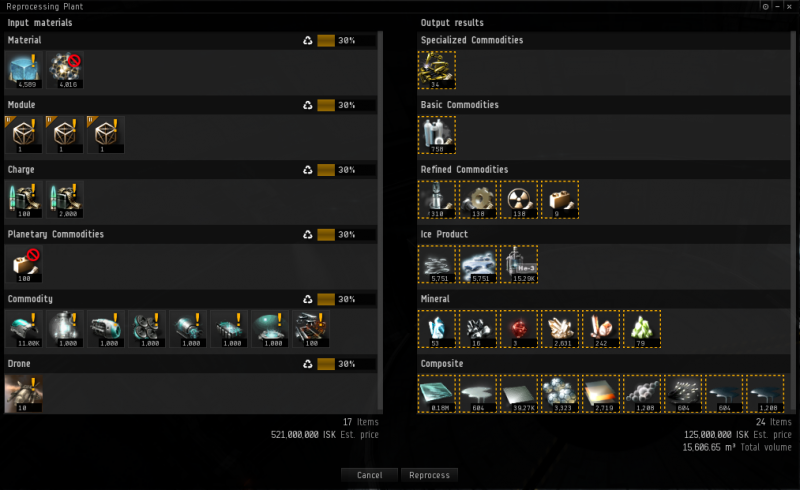
Various skills, different POS facilities, and station taxes will affect how much material is returned to you from reprocessing. It may not be profitable for you to reprocess some things if your skills are fairly low (the Reprocess window gives approximate ISK values on inputs and outputs, but it is only an approximation). See the page on Reprocessing for more details.
Reprocessing is the same activity as refining. All references to refining can be read as reprocessing; the terms are interchangeable.
Ore & Ice Compression
Moving either ore or minerals between systems can be quite a chore, given the volumes involved - even a small operation could well require multiple freighter journeys to move materials to your build system. This is where ore compression comes in useful. Ore compression turns (for example) 100 units of Veldspar into 1 unit of Compressed Veldspar, which takes up only 1.5% of the volume (i.e. a compression ratio of 67:1). This compressed ore can then be reprocessed into minerals, obtaining the same amount of minerals as if you had reprocessed directly from the ore to minerals.
No skills are directly required for ore & ice compression, but you will need either one of the following pieces of equipment:
- Compression Array
- This is a POS structure with 20 million m³ of space - comfortably holding 20 freighter's worth of ore. It can be anchored in any security space, including hi-sec.
- Rorqual
- The Rorqual, when deployed into its industrial configuration, can also compress ore and ice. It can't compress normally, only when the industrial core is active.
To compress ore or ice using either of these methods, you merely need to place the uncompressed ore/ice in the array (or ore hold) and right-click it > Compress: you will immediately receive a stack of compressed ore/ice. Compression is instant, and unaffected by skills. 100 units of ore gives 1 unit of compressed ore, whilst 1 unit of ice gives 1 unit of compressed ice. The table below gives the compression ratios for different types of ore (different variants of the same ore have the same compression ratio as their base ore):
| Ore
|
Ore volume (m³)
|
Compressed ore volume (m³)
|
Compression ratio (%)
|
| Arkonor |
16 |
3.08 |
519
|
| Bistot |
16 |
6.11 |
262
|
| Crokite |
16 |
7.81 |
205
|
| Dark Ochre |
8 |
3.27 |
245
|
| Gneiss |
5 |
1.03 |
485
|
| Hedbergite |
3 |
0.14 |
2143
|
| Hemorphite |
3 |
0.16 |
1875
|
| Jaspet |
2 |
0.15 |
1333
|
| Kernite |
1.2 |
0.19 |
632
|
| Mercoxit |
40 |
0.10 |
40,000
|
| Omber |
0.6 |
0.07 |
857
|
| Plagioclase |
0.35 |
0.15 |
233
|
| Pyroxeres |
0.3 |
0.16 |
188
|
| Scordite |
0.15 |
0.19 |
79
|
| Spodumain |
16 |
16.0 |
100
|
| Veldspar |
0.1 |
0.15 |
67
|
| Ice |
1000 |
100 |
10
|
Planetary Interaction
- Main article: Planetary Interaction
Basic materials can be extracted from the vast majority of planets in New Eden. These raw materials can then be routed through industrial facilities on the planets to manufacture more specialised planetary materials. Planetary materials are used in T2 ship and module manufacture, POS fuel, and many other items.
Planetary Interaction is an excellent source of passive income. You can set up your extractors twice a week, automatically route your minerals, and you only have to fly to the Customs Office once a week to pick up your planetary materials to sell on the market (or use in your own manufacturing). Alternatively you can put in more effort for more ISK, by setting the extractors more often. See the page on Planetary Interaction for further details on how to set up your colonies and what to extract.
Salvaging
- Main article: Guide To Salvaging
Salvaging is finding useful items from wrecks. Any ship wreck in EVE Online can be salvaged (you may need very high skills for some large, advanced wrecks), to retrieve salvage materials. Salvage is then used in the manufacture of rigs. Salvaging other people's wrecks is not technically stealing, although many players will get upset if you go around salvaging wrecks that are 'theirs'.
Ancient salvage is retrieved from wrecks of Sleepers, which live in w-space systems, and is used in T3 production.
Moon Mining
Moons in 0.5 security space and below are a vitally important source of raw materials for all T2 manufacture, and some T1 manufacture. Moon Mining is an activity requiring POSes, and the ability to defend those POSes, and thus is usually done on an alliance level. Attempting a solo moon mining operation will most likely not be profitable.
Moon materials are required for building Advanced Components, which are used in the manufacture of all T2 items. Moon materials can be found in the Reaction Materials section of the market (raw moon materials are 'reacted' together in POS reactor arrays to form advanced materials).
The Lifeblood expansion was released on October 24, 2017, and brought with it substantial changes to the process of moon mining. Previously moon mining was completed using player-owned starbases, but with the Lifeblood expansion, once a moon has been identified as a good candidate, a refinery equipped with a moon mining drill service module is anchored near the moon mining beacon. The moon mining drill can then be activated to extract a chunk of the moon over a period of 6 to 56 days, slowly pulling the chunk closer to the refinery. For further information, consult Moon mining.
Gas Huffing
- Main article: Gas Cloud Mining
Gas clouds in w-space and in losec are a source of materials, for T3 production and manufacturing medical boosters, respectively. The Venture is an excellent gas huffer, although battlecruisers can also be good gas huffers, and you will need to train up Gas Cloud Harvesting to be able to use the harvesting modules.
Gas from wormhole space systems is reacted together with minerals in a polymer reaction as part of the T3 production process. Gas from known space systems is used to produce combat boosters (also known as drugs). Hisec (and some losec) gas is used to produce basic Synth drugs, which provide small bonuses for a short time and can be used anywhere. Nullsec (and most losec) gas is used to produce much harder drugs, with large bonuses (and possible side-effects), and that are illegal in hisec.
Other Material Sources
There are various other sources of materials that may be needed in the research, invention or manufacture of some obscure blueprints.
- Exploration of Data or Relic cosmic signatures in k-space can yield datacores and other research materials
- Loyalty point stores for some corporations (especially Factional Warfare corps) sell research materials
- You can find some industry materials sold by NPCs on the market (for example, Data Sheets).


