
More actions
removed removed ship |
m Renamed Prototype to Compact |
||
| Line 80: | Line 80: | ||
The Magnate has just three mid slots—the fewest of any exploration frigate—to fit exploration and propulsion modules. These slots are typically filled with a microwarpdrive and a data and relic analyzer, leaving no room for the scanning upgrade arrays that other racial exploration frigates can fit. This is not a critical failing, and a Magnate pilot can compensate with Gravity Capacitor Upgrade rigs and improved Astrometrics skills. (There are single modules that do both data and relic analysis and that would make room, but they aren’t worth the decrease in performance and/or increased cost.) The Magnate does have the advantage of the strongest tank of any Tech I explorer, and plenty of low slots to reinforce this tank. But it’s not a great advantage, because nearly any tackled explorer is a dead explorer, and so the low slots are better fit with inertial stabilizers and/or a warp stabilizer for faster escapes. (Keep in mind that warp stabilizers reduce lock range and speed. Having more than one makes locking sites uncomfortably slow.) | The Magnate has just three mid slots—the fewest of any exploration frigate—to fit exploration and propulsion modules. These slots are typically filled with a microwarpdrive and a data and relic analyzer, leaving no room for the scanning upgrade arrays that other racial exploration frigates can fit. This is not a critical failing, and a Magnate pilot can compensate with Gravity Capacitor Upgrade rigs and improved Astrometrics skills. (There are single modules that do both data and relic analysis and that would make room, but they aren’t worth the decrease in performance and/or increased cost.) The Magnate does have the advantage of the strongest tank of any Tech I explorer, and plenty of low slots to reinforce this tank. But it’s not a great advantage, because nearly any tackled explorer is a dead explorer, and so the low slots are better fit with inertial stabilizers and/or a warp stabilizer for faster escapes. (Keep in mind that warp stabilizers reduce lock range and speed. Having more than one makes locking sites uncomfortably slow.) | ||
The exploration Magnate is also commonly fitted with a | The exploration Magnate is also commonly fitted with a Compact or Improved Cloaking Device, so that the ship can cloak while probing signatures in unsafe space. The Magnate cannot, however, fit a Covert Ops Cloaking Device. So, when cloaked, it cannot warp and suffers a significant penalty to speed. | ||
Tech I exploration frigates have the largest cargo capacity of any frigate. This makes the Magnate a speedy freight courier and distribution mission runner. By fitting the ship with expanded cargohold modules and cargohold optimization rigs, it is possible to build a Magnate that can carry just over 1600 m3 of cargo, the most of any frigate. Or, by exchanging some of these for warp stabs, the Magnate can be made into a low-sec courier that can evade insta-pointing gate camps. | Tech I exploration frigates have the largest cargo capacity of any frigate. This makes the Magnate a speedy freight courier and distribution mission runner. By fitting the ship with expanded cargohold modules and cargohold optimization rigs, it is possible to build a Magnate that can carry just over 1600 m3 of cargo, the most of any frigate. Or, by exchanging some of these for warp stabs, the Magnate can be made into a low-sec courier that can evade insta-pointing gate camps. | ||
Revision as of 06:09, 12 August 2020

RELATED UNI-WIKI REFERENCES
|
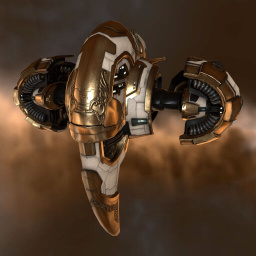
This Magnate-class frigate is one of the most decoratively designed ship classes in the Amarr Empire, considered to be a pet project for a small, elite group of royal ship engineers for over a decade. The frigate's design has gone through several stages over the past decade, and new models of the Magnate appear every few years. The most recent versions of this ship – the Silver Magnate and the Gold Magnate – debuted as rewards in the Amarr Championships in YC105, though the original Magnate design is still a popular choice among Amarr pilots. SHIP BONUSES
Amarr Frigate bonuses (per skill level):
Ship Attributes
|






Summary
The Magnate is the Amarr Exploration Frigate. Like all Tech I exploration frigates, the Magnate receives skill-dependent bonuses to scanner probe strength. The Magnate excels at probing cosmic signatures in all security levels of space. The Magnate also receives a role bonus (independent of pilot skill level) to relic and data analyzer virus strength, which helps the Magnate pilot crack exploration sites. With these two bonuses, the Magnate is a strong starter frigate for Amarr pilots interested in Exploration. And while Magnate pilots eventually skill into Tech II Covert Ops exploration ships (like the Anathema), there isn’t much non-combat exploration content that the Magnate can’t complete.
The Magnate has just three mid slots—the fewest of any exploration frigate—to fit exploration and propulsion modules. These slots are typically filled with a microwarpdrive and a data and relic analyzer, leaving no room for the scanning upgrade arrays that other racial exploration frigates can fit. This is not a critical failing, and a Magnate pilot can compensate with Gravity Capacitor Upgrade rigs and improved Astrometrics skills. (There are single modules that do both data and relic analysis and that would make room, but they aren’t worth the decrease in performance and/or increased cost.) The Magnate does have the advantage of the strongest tank of any Tech I explorer, and plenty of low slots to reinforce this tank. But it’s not a great advantage, because nearly any tackled explorer is a dead explorer, and so the low slots are better fit with inertial stabilizers and/or a warp stabilizer for faster escapes. (Keep in mind that warp stabilizers reduce lock range and speed. Having more than one makes locking sites uncomfortably slow.)
The exploration Magnate is also commonly fitted with a Compact or Improved Cloaking Device, so that the ship can cloak while probing signatures in unsafe space. The Magnate cannot, however, fit a Covert Ops Cloaking Device. So, when cloaked, it cannot warp and suffers a significant penalty to speed.
Tech I exploration frigates have the largest cargo capacity of any frigate. This makes the Magnate a speedy freight courier and distribution mission runner. By fitting the ship with expanded cargohold modules and cargohold optimization rigs, it is possible to build a Magnate that can carry just over 1600 m3 of cargo, the most of any frigate. Or, by exchanging some of these for warp stabs, the Magnate can be made into a low-sec courier that can evade insta-pointing gate camps.
The Magnate can be fit for combat probing, by using an Expanded Probe Launcher in place of the standard Core Probe Launcher. However, combat probing requires considerably greater in-game and pilot skill than site probing. Successful combat probers need to be able to locate targets in a single quick scan, or at most two. Pilots that have the Astrometrics skill levels required to do this, and have the experience necessary to use D-Scan intelligence to pinpoint those targets before scanning, are typically already trained into Covert Ops frigates anyway.
Skills
Further information about additional or recommended skills to pilot Magnate for a specific or its common role(s) can be written here.
Fitting
<wikifit shipid="29248" doctrineid="35020" />
Tactics
New exploration Magnate pilots should read the UniWiki guides to Exploration and Bookmarks, as well as attend Bookmarking 101 and Exploration 101 practicals, to learn tips and tricks from veteran explorers.
Notes
You can add notes here.


